
Electric power transmission
A process in the delivery of electricity to consumers, is the bulk transfer of electrical power. Typically, power transmission is between the power plant and a substation near a populated area. Electricity distribution is the delivery from the substation to the consumers. Electric power transmission allows distant energy sources (such as hydroelectric power plants) to be connected to consumers in population centers, and may allow exploitation of low-grade fuel resources that would otherwise be too costly to transport to generating facilities.
Due to the large amount of power involved, transmission normally takes place at high voltage (110 kV or above). Electricity is usually transmitted over long distance through overhead power transmission lines. Underground power transmission is used only in densely populated areas due to its high cost of installation and maintenance, and because the high reactive power produces large charging currents and difficulties in voltage management.
A power transmission system is sometimes referred to colloquially as a "grid"; however, for reasons of economy, the network is not a mathematical grid. Redundant paths and lines are provided so that power can be routed from any power plant to any load center, through a variety of routes, based on the economics of the transmission path and the cost of power. Much analysis is done by transmission companies to determine the maximum reliable capacity of each line, which, due to system stability considerations, may be less than the physical or thermal limit of the line. Deregulation of electricity companies in many countries has led to renewed interest in reliable economic design of transmission networks. However, in some places the gaming of a deregulated energy system has led to disaster, such as that which occurred during the California electricity crisis of 2000 and 2001.[citation needed]
AC power transmission
AC power transmission is the transmission of electric power by alternating current. Usually transmission lines use three phase AC current. Single phase AC current is sometimes used in a railway electrification system. In urban areas, trains may be powered by DC at 600 volts or so.
Overhead conductors are not covered by insulation. The conductor material is nearly always an aluminum alloy, made into several strands and possibly reinforced with steel strands. Conductors are a commodity supplied by several companies worldwide. Improved conductor material and shapes are regularly used to allow increased capacity and modernize transmission circuits. Conductor sizes in overhead transmission work range in size from #6 American wire gauge (about 12 square millimetres) to 1,590,000 circular mils area (about 750 square millimetres), with varying resistance and current-carrying capacity. Thicker wires would lead to a relatively small increase in capacity due to the skin effect, that causes most of the current to flow close to the surface of the wire.
Today, transmission-level voltages are usually considered to be 110 kV and above. Lower voltages such as 66 kV and 33 kV are usually considered sub-transmission voltages but are occasionally used on long lines with light loads. Voltages less than 33 kV are usually used for distribution. Voltages above 230 kV are considered extra high voltage and require different designs compared to equipment used at lower voltages.
Overhead transmission lines are uninsulated wire, so design of these lines requires minimum clearances to be observed to maintain safety.
History
In the early days of commercial use of electric power, transmission of electric power at the same voltage as used by lighting and mechanical loads restricted the distance between generating plant and consumers. Originally generation was with direct current, which could not easily be increased in voltage for long-distance transmission. Different classes of loads, for example, lighting, fixed motors, and traction (railway) systems, required different voltages and so used different generators and circuits. [1]
At an AIEE meeting on May 16, 1888, Nikola Tesla delivered a lecture entitled A New System of Alternating Current Motors and Transformers, describing the equipment which allowed efficient generation and use of alternating currents. Tesla's disclosures, in the form of patents, lectures and technical articles, are useful for understanding the history of the modern system of power transmission. Ownership of the rights to the Tesla patents was a key commercial advantage to the Westinghouse Company in offering a complete alternating current power system for both lighting and power.
The so-called "universal system" used transformers both to couple generators to high-voltage transmission lines, and to connect transmission to local distribution circuits. By a suitable choice of utility frequency, both lighting and motor loads could be served. Rotary converters and later mercury-arc valves and other rectifier equipment allowed DC load to be served by local conversion where needed. Even generating stations and loads using different frequencies could also be interconnected using rotary converters. By using common generating plants for every type of load, important economies of scale were achieved, lower overall capital investment was required, load factor on each plant was increased allowing for higher efficiency, allowing for a lower cost of energy to the consumer and increased overall use of electric power.
By allowing multiple generating plants to be interconnected over a wide area, electricity production cost was reduced. The most efficient available plants could be used to supply the varying loads during the day. Reliability was improved and capital investment cost was reduced, since stand-by generating capacity could be shared over many more customers and a wider geographic area. Remote and low-cost sources of energy, such as hydroelectric power or mine-mouth coal, could be exploited to lower energy production cost. [2]
The first transmission of three-phase alternating current using high voltage took place in 1891 during the international electricity exhibition in Frankfurt. A 25 kV transmission line, approximately 175 kilometers long, connected Lauffen on the Neckar and Frankfurt.
Initially transmission lines were supported by porcelain pin-and-sleeve insulators similar to those used for telegraphs and telephone lines. However, these had a practical limit of 40 kV. In 1907, the invention of the disc insulator by Harold W. Buck of the Niagara Falls Power Corporation and Edward M. Hewlett of General Electric allowed practical insulators of any length to be constructed for higher voltages. The first large scale hydroelectric generators in the USA were installed at Niagara Falls and provided electricity to Buffalo, New York via power transmission lines. A statue of Tesla stands at Niagara Falls today in tribute to his contributions.
Voltages used for electric power transmission increased throughout the 20th century. By 1914 fifty-five transmission systems operating at more than 70,000 V were in service, the highest voltage then used was 150,000 volts. [3] The first three-phase alternating current power transmission at 110 kV took place in 1912 between Lauchhammer and Riesa, Germany. On April 17, 1929 the first 220 kV line in Germany was completed, running from Brauweiler near Cologne, over Kelsterbach near Frankfurt, Rheinau near Mannheim, Ludwigsburg-Hoheneck near Austria. The masts of this line were designed for eventual upgrade to 380 kV. However the first transmission at 380 kV in Germany was on October 5, 1957 between the substations in Rommerskirchen and Ludwigsburg-Hoheneck. In 1967 the first extra-high-voltage transmission at 735 kV took place on a Hydro-Québec transmission line. In 1982 the first transmission at 1200 kV was in the Soviet Union.
The rapid industrialization in the 20th century made electrical transmission lines and grids a critical part of the economic infrastructure in most industrialized nations. Interconnection of local generation plants and small distribution networks was greatly spurred by the requirements of World War I, where large electrical generating plants were built by governments to provide power to munitions factories; later these plants were connected to supply civil load through long-distance transmission. [4]
Small municipal electrical utilities did not necessarily desire to reduce the cost of each unit of electricity sold; to some extent, especially during the period 1880-1890, electrical lighting was considered a luxury product and electric power was not substituted for steam power. Engineers such as Samuel Insull in the United States and Sebastian Z. De Ferranti in the United Kingdom were instrumental in overcoming technical, economic, regulatory and political difficulties in development of long-distance electric power transmission. By introduction of electric power transmission networks, in the city of London the cost of a kilowatthour was reduced to one-third in a ten-year period. [5]
In 1926 electrical networks in the United Kingdom began to be interconnected in the National Grid, initially operating at 132,000 volts.
Bulk power transmission
Engineers design transmission networks to transport the energy as efficiently as feasible, while at the same time taking into account economic factors, network safety and redundancy. These networks use components such as power lines, cables, circuit breakers, switches and transformers.

A transmission substation decreases the voltage of electricity coming in allowing it to connect from long distance, high voltage transmission, to local, lower voltage, distribution. It also reroutes power to other transmission lines that serve local markets. The substation may also "reboost" power allowing it to travel greater distances from the power generation source along the high voltage transmission lines.This is the
PacifiCorp Hale Substation, Orem, Utah.
Transmission efficiency is improved by increasing the voltage using a step-up transformer, which reduces the current in the conductors, while keeping the power transmitted nearly equal to the power input. The reduced current flowing through the conductor reduces the losses in the conductor and since, according to Joule's Law, the losses are proportional to the square of the current, halving the current makes the transmission loss one quarter the original value.
A transmission grid is a network of power stations, transmission circuits, and substations. Energy is usually transmitted within the grid with three-phase AC. DC systems require relatively costly conversion equipment which may be economically justified for particular projects. Single phase AC is used only for distribution to end users since it is not usable for large polyphase induction motors. In the 19th century two-phase transmission was used, but required either three wires with unequal currents or four wires. Higher order phase systems require more than three wires, but deliver marginal benefits.
The capital cost of electric power stations is so high, and electric demand is so variable, that it is often cheaper to import some portion of the variable load than to generate it locally. Because nearby loads are often correlated (hot weather in the Southwest portion of the United States might cause many people there to turn on their air conditioners), imported electricity must often come from far away. Because of the economics of load balancing, transmission grids now span across countries and even large portions of continents. The web of interconnections between power producers and consumers ensures that power can flow even if a few links are inoperative.
The unvarying (or slowly varying over many hours) portion of the electric demand is known as the "base load", and is generally served best by large facilities (and therefore efficient due to economies of scale) with low variable costs for fuel and operations, i.e. nuclear, coal, hydro. Renewables such as solar, wind, ocean/tidal, etc. are not considered "base load" but can still add power to the grid. Smaller- and higher-cost sources such as combined cycle or combustion turbine plants that run on natural gas are then added as needed.
Long-distance transmission of electricity (thousands of miles) is cheap and efficient, with costs of US$ 0.005 to 0.02 per kilowatt-hour (compared to annual averaged large producer costs of US$ 0.01 to US$ 0.025 per kilowatt-hour, retail rates upwards of US$ 0.10 per kilowatt-hour, and multiples of retail for instantaneous suppliers at unpredicted highest demand moments).[6] Thus distant suppliers can be cheaper than local sources (e.g. New York City buys a lot of electricity from Canada). Multiple local sources (even if more expensive and infrequently used) can make the transmission grid more fault tolerant to weather and other disasters that can disconnect distant suppliers.
Long distance transmission allows remote renewable energy resources to be used to displace fossil fuel consumption. Hydro and wind sources can't be moved closer to high population cities, and solar costs are lowest in remote areas where local power needs are the least. Connection costs alone can determine whether any particular renewable alternative is economically sensible. Costs can be prohibitive for transmission lines.
Grid input
At the generating plants the energy is produced at a relatively low voltage of up to 30 kV (Grigsby, 2001, p. 4-4), then stepped up by the power station transformer to a higher voltage (115 kV to 765 kV AC, ± 250-500 kV DC, varying by country) for transmission over long distances to grid exit points (substations).
Losses
Transmitting electricity at high voltage reduces the fraction of energy lost to Joule heating. For a given amount of power, a higher voltage reduces the current and thus the resistive losses in the conductor. For example, raising the voltage by a factor of 10 reduces the current by a corresponding factor of 10 and therefore the  losses by a factor of 100, provided the same sized conductors are used in both cases. Even if the conductor size is reduced x10 to match the lower current the losses are still reduced x10. Long distance transmission is typically done with overhead lines at voltages of 115 to 1,200 kV. However, at extremely high voltages, more than 2,000 kV between conductor and ground, corona discharge losses are so large that they can offset the lower resistance loss in the line conductors.
Transmission and distribution losses in the USA were estimated at 7.2% in 1995 [2], and in the UK at 7.4% in 1998. [3]
As of 1980, the longest cost-effective distance for electricity was 4,000 miles (7,000 km), although all present transmission lines are considerably shorter. (see Present Limits of High-Voltage Transmission)
In an alternating current transmission line, the inductance and capacitance of the line conductors can be significant. The currents that flow in these components of transmission line impedance constitute reactive power, which transmits no energy to the load. Reactive current flow causes extra losses in the transmission circuit. The ratio of real power (transmitted to the load) to apparent power is the power factor. As reactive current increases, the reactive power increases and the power factor decreases. For systems with low power factors, losses are higher than for systems with high power factors. Utilities add capacitor banks and other components throughout the system — such as phase-shifting transformers, static VAR compensators, and flexible AC transmission systems (FACTS) — to control reactive power flow for reduction of losses and stabilization of system voltage.
Electrical power is always partially lost by transmission. This applies to short distances such as between components on a printed circuit board as well as to cross country high voltage lines. The major component of power loss is due to ohmic losses in the conductors and is equal to the product of the square of the current and the resistance of the wire:
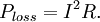
For a system which delivers a power, P, at unity power factor at a particular voltage, V, the current flowing through the cables is given by  . Thus, the power lost in the lines,
Therefore, the power lost is proportional to the resistance and inversely proportional to the square of the voltage. A higher transmission voltage reduces the current and thus the power lost during transmission.
In addition, a low resistance is desirable in the cable. While copper cable could be used, aluminium alloy is preferred due to its much better conductivity to weight ratio making it lighter to support, as well as its lower cost. The aluminium is normally mechanically supported on a steel core.
HVDC
-
High voltage direct current (HVDC) is used to transmit large amounts of power over long distances or for interconnections between asynchronous grids. When electrical energy is required to be transmitted over very long distances, it can be more economical to transmit using direct current instead of alternating current. For a long transmission line, the value of the smaller losses, and reduced construction cost of a DC line, can offset the additional cost of converter stations at each end of the line. Also, at high AC voltages significant (although economically acceptable) amounts of energy are lost due to corona discharge, the capacitance between phases or, in the case of buried cables, between phases and the soil or water in which the cable is buried.
HVDC links are sometimes used to stabilize against control problems with the AC electricity flow. In other words, to transmit AC power as AC when needed in either direction between Seattle and Boston would require the (highly challenging) continuous real-time adjustment of the relative phase of the two electrical grids. With HVDC instead the interconnection would: (1) Convert AC in Seattle into HVDC. (2) Use HVDC for the three thousand miles of cross country transmission. Then (3) convert the HVDC to locally synchronized AC in Boston, and optionally in other cooperating cities along the transmission route. One prominent example of such a transmission line is the Pacific DC Intertie located in the Western United States.
Grid exit
At the substations, transformers are again used to step the voltage down to a lower voltage for distribution to commercial and residential users. This distribution is accomplished with a combination of sub-transmission (33 kV to 115 kV, varying by country and customer requirements) and distribution (3.3 to 25 kV). Finally, at the point of use, the energy is transformed to low voltage (100 to 600 V, varying by country and customer requirements).
Limitations
The amount of power that can be sent over a transmission line is limited. The origins of the limits vary depending on the length of the line. For a short line, the heating of conductors due to line losses sets a "thermal" limit. If too much current is drawn, conductors may sag too close to the ground, or conductors and equipment may be damaged by overheating. For intermediate-length lines on the order of 100 km (60 miles), the limit is set by the voltage drop in the line. For longer AC lines, system stability sets the limit to the power that can be transferred. Approximately, the power flowing over an AC line is proportional to the sine of the phase angle between the receiving and transmitting ends. Since this angle varies depending on system loading and generation, it is undesirable for the angle to approach 90 degrees. Very approximately, the allowable product of line length and maximum load is proportional to the square of the system voltage. Series capacitors or phase-shifting transformers are used on long lines to improve stability. High-voltage direct current lines are restricted only by thermal and voltage drop limits, since the phase angle is not material to their operation.
Communications
Operators of long transmission lines require reliable communications for control of the power grid and, often, associated generation and distribution facilities. Fault-sensing protection relays at each end of the line must communicate to monitor the flow of power into and out of the protected line section so that faulted conductors or equipment can be quickly de-energized and the balance of the system restored. Protection of the transmission line from short circuits and other faults is usually so critical that common carrier telecommunications are insufficiently reliable. In remote areas a common carrier may not be available at all. Communication systems associated with a transmission project may use:
Rarely, and for short distances, a utility will use pilot-wires strung along the transmission line path. Leased circuits from common carriers are not preferred since availability is not under control of the electric power transmission organization.
Transmission lines can also be used to carry data: this is called power-line carrier, or PLC. PLC signals can be easily received with a radio for the long wave range.
Optical fibers can be included in the stranded conductors of a transmission line, in the overhead shield wires. These cables are known as OPGW or Optical Ground Wire. Sometimes a standalone cable is used, ADSS or All Dielectric Self Supporting cable, attached to the transmission line cross arms.

110 kV double circuit power line of EnBW AG near Leonberg, Germany with an aerial cable mounted like a garland on the ground conductor
Some jurisdictions, such as Minnesota, prohibit energy transmission companies from selling surplus communication bandwidth or acting as a telecommunications common carrier. Where the regulatory structure permits, the utility can sell capacity in extra "dark fibers" to a common carrier, providing another revenue stream for the line.
Electricity market reform
Some regulators, economists, and many power companies regard electric transmission to be a natural monopoly[7][8] and there are moves in many countries to separately regulate transmission (see Electricity market).
Spain was the first country to establish a Regional Transmission Organization. In that country transmission operations and market operations are controlled by separate companies. The transmission system operator is Red Eléctrica de España (REE) [4] and the wholesale electricity market operator is Operador del Mercado Ibérico de Energía - Polo Español, S.A. (OMEL) [5]. Spain's transmission system is interconnected with those of France, Portugal, and Morocco.
In the United States and parts of Canada, electrical transmission companies operate independently of generation and distribution companies.
Merchant transmission
Merchant transmission is an arrangement where a third party constructs and operates electric transmission lines through the franchise area of an unrelated utility. Advocates of merchant transmission[who?] claim that this will create competition to construct the most efficient and lowest cost additions to the transmission grid. Merchant transmission projects typically involve DC lines because it is easier to limit flows to paying customers.
The only operating merchant transmission project in the United States is the Cross Sound Cable from Long Island, New York to New Haven, Connecticut, although additional projects have been proposed.
There are five merchant transmission interconnectors between five states in Australia: the DirectLink, QNI, MurrayLink and Southern Link between New South Wales and South Australia and Basslink between Tasmania and Victoria.
A major barrier to wider adoption of merchant transmission is the difficulty in identifying who benefits from the facility so that the beneficiaries will pay the toll. Also, it is difficult for a merchant transmission line to compete when the alternative transmission lines are subsidized by other utility businesses.[9]
Health concerns
-
Some research has found that exposure to elevated levels of ELF magnetic fields such as those originating from electric power transmission lines may be implicated in a number of adverse health effects. These include, but are not limited to, childhood leukemia [10], adult leukemia[11], breast cancer[12], neurodegenerative diseases (such as amyotrophic lateral sclerosis)[13][14][15], Miscarriage[16][17][18], and clinical depression. Although there seems to be a small statistical correlation between various diseases and living near power lines, the physical mechanism is not clear. One proposed mechanism is that the electric fields around power lines attract aerosol pollutants.[19][20]
One possible response to the potential dangers of overhead power lines is to place them underground. According to the British Stakeholder Advisory Group on ELF EMFs[21], the cost of burying cables at transmission voltages is around GBP 10M/km, compared to GBP 0.5-1M/km for overhead lines.
Underground cables eliminate the electric field and reduce the width over which the magnetic field is elevated.[22] However, in reality, protection from the dangers of electromagnetic (EM) fields is seldom the driving concern when burying power lines.
The strongest evidence linking EMF to cancer was fabricated. Most people, when quizzed, have heard of the link between EMF's and cancer, but relatively few people have heard of the fabricated data leaving a public perception that power lines are far more dangerous than they are.[6] Indeed, the UN World Health Organization has concluded "...a cause-and-effect link between ELF field exposure and cancer has not been confirmed."[7]
Special transmission
Grids for railways
In some countries where electric trains run on low frequency AC (e.g. 16.7 Hz and 25 Hz) power, there are separate single phase traction power networks operated by the railways. These grids are fed by separate generators in some traction powerstations or by traction current converter plants from the public three phase AC network.
Radio frequency power transmission
-
Some radio broadcasters use specialized transmission lines to carry the output of high-power transmitters to the antenna.
Superconducting cables
High-temperature superconductors promise to revolutionize power distribution by providing lossless transmission of electrical power. The development of superconductors with transition temperatures higher than the boiling point of liquid nitrogen has made the concept of superconducting power lines commercially feasible, at least for high-load applications. [23] It has been estimated that the waste would be halved using this method, since the necessary refrigeration equipment would consume about half the power saved by the elimination of the majority of resistive losses. Such cables are particularly suited to high load density areas such as the business district of large cities, where purchase of a wayleave for cables would be very costly. [8]
Single wire earth return
-
Single wire earth return (SWER) or single wire ground return is a single-wire transmission line for supplying single-phase electrical power for a electrical grid to remote areas at low cost. It is principally used for rural electrification, but also finds use for larger isolated loads such as water pumps, and light rail. Single wire earth return is also used for HVDC over submarine power cables.
Wireless power transmission
-
Every radio transmitter emits power wirelessly. Both Nikola Tesla and Hidetsugu Yagi attempted to devise systems for large scale wireless power transmission. Tesla claimed to have succeeded.[24][25][26][27][28] Yagi also proposed a similar concept, but the engineering problems proved to be more onerous than conventional systems. His work, however, led to the invention of the Yagi antenna.
Another form of wireless power transmission has been studied for transmission of power from solar power satellites to the earth. A high power array of microwave transmitters would beam power to a rectenna. Major engineering and economic challenges face any solar power satellite project.
Another form is the operation of a crystal radio is powered by the radio station it is tuned to, however the energetic efficiency is extremely low. Small scale wireless power was demonstrated as early as 1831 by Michael Faraday and by 1888 Heinrich Rudolf Hertz had proven that natural radio waves exist and can be captured.
Records
- Highest transmission voltage (AC): 1,150 kV on Powerline Ekibastuz-Kokshetau (Kazakhstan)
- Highest transmission voltage (DC): +/-600 kV on HVDC Itaipu (Brazil)
- Highest pylons: Yangtze River Crossing (height: 345 m (1,132 ft))
- Longest power line: Inga-Shaba (length: 1,700 kilometres (1,056 mi))
- Longest span of power line: 5,376 m (17,638 ft) at Ameralik Span
- Longest submarine cables:
- NorNed, North Sea - (length of submarine/underground cable: 580 kilometres (360 mi))
- Basslink, Bass Strait - (length of submarine/underground cable: 290 kilometres (180 mi), total length: 357.4 kilometres (222 mi))
- Baltic-Cable, Baltic Sea - (length of submarine/underground cable: 249 kilometres (155 mi), total length: 261 kilometres (162 mi))
See also
Notes
- ^ Hughes
- ^ Thomas P. Hughes, Networks of Power: Electrification in Western Society 1880-1930, The Johns Hopkins University Press,Baltimore 1983 ISBN 0-8018-2873-2
- ^ Bureau of Census data reprinted in Hughes, pp. 282-283
- ^ Hughes, pp. 293-295
- ^ Hughes pp.
- ^ "Present Limits of Very Long Distance Transmission Systems"
- ^ Raghuvir Srinivasan (August 15, 2004). Power transmission business is a natural monopoly. The Hindu Business Line. The Hindu. Retrieved on 2008-01-31.
- ^ Lynne Kiesling (August 18, 2003). Rethink the Natural Monopoly Justification of Electricity Regulation. Reason Foundation. Retrieved on 2008-01-31.
- ^ Fiona Woolf (February 2003). Global Transmission Expansion. Pennwell Books, 226, 247. ISBN 0-87814-862-0.
- ^ Albohm, Anders; Elisabeth Cardis, Adele Green, Martha Linet, David Savitz, Anthony Swerdlow (December 2001). "Review of the Epidemiologic Literature on EMF and Health". Environ Health Perspect. 109 (S6).
- ^ Tynes, Tore; L Klaeboe, T Haldorsen (May 2003). "Residential and occupational exposure to 50 Hz magnetic fields and malignant melanoma: a population based study". Occup Environ Med 60 (5): 343-7.
- ^ Hansen, J (January 2001). "Increased breast cancer risk among women who work predominantly at night". Epidemiology 12 (1): 74-7.
- ^ Feychting, Maria; Anders Ahlbom, F Jonsson, NL Pederson (July 2003). "Occupational magnetic field exposure and neurodegenerative disease". Epidemiology 14 (4): 413-9.
- ^ Hakansson, Niklas; P Gustavsson, Birgitte Floderus, Christof Johanen (July 2003). "Neurodegenerative diseases in welders and other workers exposed to high levels of magnetic fields". Epidemiology 14 (4): 420-6.
- ^ Albohm, Anders (2001). "Neurodegenerative diseases, suicide and depressive symptoms in relation to EMF.". Bioelectromagnetics (Suppl 5): S132-43.
- ^ Lee, GM; Michael Yost, RR Neutra, L Hristova, RA Hiatt (January 2002). "A nested case-control study of residential and personal magnetic field measures and miscarriages". Epidemiology 13 (1): 21-31.
- ^ Li, De-Kun; Roxana Odouli, S Wi, T Janevic, I Golditch, TD Bracken, R Senior, R Rankin, R Iriye (January 2002). "A population-based prospective cohort study of personal exposure to magnetic fields during pregnancy and the risk of miscarriage". Epidemiology 13 (1): 9-20.
- ^ Cao, YN; Y Zhang, Y Liu (August 2006). "Effects of exposure to extremely low frequency electromagnetic fields on reproduction of female mice and development of offsprings". Zhonghua Lao Dong Wei Sheng Zhi Ye Bing Za Zhi 24 (8): 468-70.
- ^ Fews, Peter; Denis Henshaw, Paul Keitch, Julie Close, Richard Wilding (December 1999). "Increased exposure to pollutant aerosols under high voltage power lines". Int J Radiat Biol. 75 (12): 1505-21.
- ^ Fews, Peter; Denis Henshaw, Richard Wilding, Paul Keitch (December 1999). "Corona ions from powerlines and increased exposure to pollutant aerosols". Int J Radiat Biol. 75 (12): 1523-31.
- ^ "SAGE first interim assessment: Power Lines and Property, Wiring in Homes, and Electrical Equipment in Homes"
- ^ UK National Grid EMF information site
- ^ Jacob Oestergaard et al., Energy losses of superconducting power transmission cables in the grid, [1]
- ^ "The Transmission of Electrical Energy Without Wires," Electrical World, March 5, 1904
- ^ Norrie, H. S., "Induction Coils: How to make, use, and repair them". Norman H. Schneider, 1907, New York. 4th edition.
- ^ Electrical Experimenter, January 1919. pg. 615
- ^ Tesla: Man Out of Time By Margaret Cheney. Page 174.
- ^ Martin, T. C., & Tesla, N. (1894). The inventions, researches and writings of Nikola Tesla, with special reference to his work in polyphase currents and high potential lighting. New York: The Electrical Engineer. Page 188.
Further reading
- Grigsby, L. L., et al. The Electric Power Engineering Handbook. USA: CRC Press. (2001). ISBN 0-8493-8578-4
- Thomas P. Hughes, Networks of Power: Electrification in Western Society 1880-1930, The Johns Hopkins University Press,Baltimore 1983 ISBN 0-8018-2873-2, an excellent overview of development during the first 50 years of commercial electric power
- Westinghouse Electric Corporation, "Electric power transmission patents; Tesla polyphase system". (Transmission of power; polyphase system; Tesla patents)
External links


